Under Pressure: A Resident’s Guide to Pediatric Hypertensive Emergencies
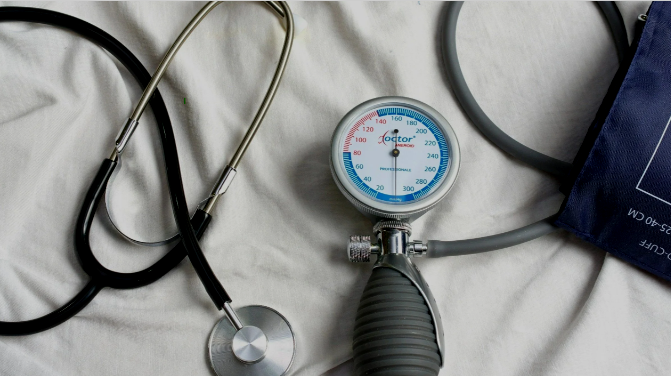
…most children are asymptomatic, which explains why even severely elevated blood pressures often go unnoticed until a child presents with seizures or obtundation…
THE CASE:
A 14-year-old male with no known past medical history presents to the emergency department with 2 days of headache and a single episode of non-bloody, non-bilious vomiting. His mother notes eye swelling over the past few weeks, which she attributes to allergies.
Vital Signs: HR 88, BP 172/114, RR 16, SpO₂ 99% on room air
Exam: Alert but uncomfortable. Bilateral periorbital edema and papilledema noted on funduscopic examination. No rashes or focal neurological deficits.
Labs: Creatinine 2.8 mg/dL, Urinalysis with 3+ protein, +RBCs
PEDIATRIC HYPERTENSION:
Hypertension (HTN) in children can be underrecognized and underdiagnosed in the emergency department (ED). Unlike adult blood pressure (BP) standards, pediatric BP thresholds depend on age, sex, and height percentiles, making “normal” a moving target that is difficult to memorize. Furthermore, most children are asymptomatic, which explains why even severely elevated BPs often go unnoticed until a child presents with seizures or obtundation. Conversely, overdiagnosis of hypertension in the ED is also common because blood pressure can be influenced by pain, stress, and anxiety. Understanding the nuances of pediatric HTN allows us to more accurately interpret BP readings in the context of each patient’s clinical presentation.
DEFINITIONS AND BLOOD PRESSURE THRESHOLDS:
The 2017 AAP Clinical Practice Guidelines updated the definition of pediatric HTN, replacing the term “prehypertension” with “elevated BP.” For children ages 1 to 13 years old, BP thresholds are percentile-based. Adult cutoffs apply for adolescents 13 years and older. Electronic medical records (EMRs) will not always pick up on age-based HTN in pediatric patients, so don’t rely on this.

Note: You are not expected to memorize the percentile cut-offs for each age but should know how to quickly find the information. Be familiar with local resources at your ED.
Hypertensive Urgency: Stage 2 or higher without evidence of end-organ damage
Hypertensive Emergency: Severely elevated BP with evidence of end-organ injury
PEARLS: When thinking about end-organ injury, think about the brain, kidneys, eyes, and heart. Don’t ignore an elevated BP if any of these systems are involved.
The most common cause of falsely elevated BP readings in pediatric patients is a cuff that is too small. If in doubt, repeat the measurement with the correct size cuff before escalating the workup. Other causes include white coat hypertension, pain, and anxiety.
Although frequently done for different reasons, blood pressures should not be obtained from the legs. They are unreliable and there are no established normal pressures.
Finding the patient’s BP in past visits may be helpful.
CHILDREN ARE NOT SMALL ADULTS:
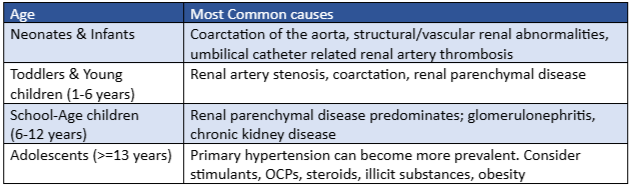
Historically, primary pediatric HTN was much less common than HTN as a result of a secondary cause. Today, in the setting of metabolic syndromes, more sedentary lifestyles, and positive family histories, a majority of pediatric HTN is the primary type, especially in older children. The younger the child, however, the more likely there is to be an underlying etiology. Notably, Stage 2 HTN and severe diastolic HTN are also more likely to be from a secondary cause. Some clues to secondary causes include hematuria, periorbital edema, recent illness (think post-streptococcal glomerulonephritis), flank pain (think renovascular), family history of HTN or renal disease, and medication lists. The most common etiologies vary by age:
CLINICAL PRESENTATION:
Do not be falsely reassured by a child who looks well. Remember a child can be well-appearing even in the setting of significant organ damage, so try to be systematic and organ focused.
Neurologic: Headaches, altered mental status, confusion, seizures (new onset seizure with HTN is a hypertensive emergency until proven otherwise), and Posterior Reversible Encephalopathy Syndrome (PRES)
Ophthalmologic: Papilledema, retinal hemorrhages, and blurry vision
Cardiovascular: Left ventricular hypertrophy (LVH), heart failure, pulmonary edema, heart murmur, and differential arm pressures (always check blood pressures in both arms and legs to evaluate for coarctation)
Renal: Hematuria, proteinuria (may simultaneously be the cause and consequence of HTN), high creatinine, edema, and in severe cases, oliguria
WORKUP:
If you have repeated the BP and it remains elevated without a reasonable explanation, consider screening labs. Your initial workup should include a basic metabolic panel (BMP), complete blood count (CBC), urinalysis with microscopy, and urine protein: creatinine ratio. You can also obtain an electrocardiogram (EKG), but this is not recommended by the 2017 AAP guidelines since the voltage criteria for LVH are neither sensitive nor specific. Obtain other tests based on suspicion:
Chest x-ray looking for cardiomegaly or pulmonary edema
Renal ultrasound with arteriovenous doppler looking for renal artery stenosis
Head computed tomography (CT) to look for brain bleeds or masses
Magnetic resonance imaging (MRI) is preferred for PRES though it is a clinical diagnosis and treatment should not be delayed for MRI
Total serum metanephrines to look for pheochromocytomas
Serum aldosterone and plasma renin activity to look for renal and primary adrenal causes
MANAGEMENT:
Hypertensive Urgency: Slow and steady wins the race. You can use oral drugs with the goal of gradual reduction in pressure over 24–48 hours, especially if the HTN is more chronic. Children who are chronically hypertensive have cerebral autoregulation. Their cerebral perfusion pressure has calibrated to the high BP and has become their “normal.” Dropping the pressure too rapidly risks cerebral hypoperfusion, ischemia, and watershed infarcts.
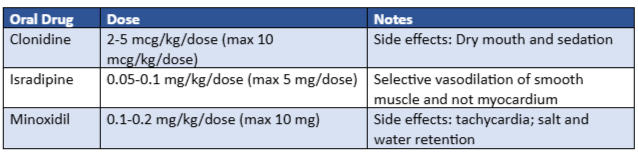
Most children can be discharged with close follow-up within 24–48 hours with a pediatrician or nephrologist if the BP responds and the workup is reassuring. Strict return precautions should be given to parents, including neurologic symptoms, worsening headaches, vision changes, or anuria.
Hypertensive Emergency:
The cardinal rule is to reduce the mean arterial pressure (MAP) by no more than 25% in the first 8 hours. Again, slow and steady wins the race. But in hypertensive emergencies, you will need intravenous access, continuous BP monitoring, an antihypertensive infusion (in consultation with nephrology), and likely admission to a higher level of care
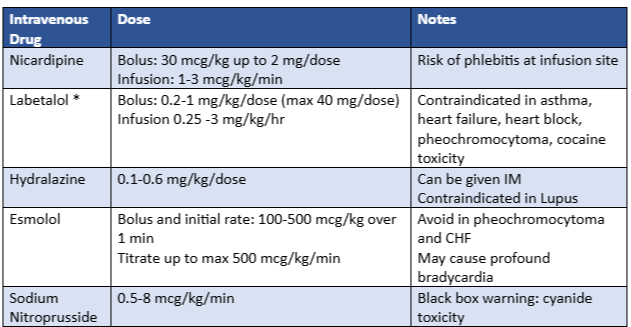
(*Hasbro Pharmacy does not have labetalol drips)
If the elevated BP is an incidental finding on repeated vital signs in the ED but you have low suspicion for brain, heart, or renal etiology, you do not necessarily have to do a workup. Ensure you make note of it to the family and arrange close follow-up with their pediatrician for repeat BP checks. Make sure you provide good return precautions as mentioned above. You should also make a referral to pediatric nephrology for a 24-hour ambulatory monitoring study (ABPM).
And of course, consult your friendly neighborhood pediatric nephrologist who can provide guidance on BP management on a case-by-case basis – including drug selection and disposition.
TAKE-HOME POINTS:
Recheck the cuff before you chase the number
The younger the child, the more likely there is a secondary cause - remember the brain, heart, and kidneys
A well-appearing child can still have end-organ damage
New-onset seizure plus HTN is a hypertensive emergency until proven otherwise
Always lower the BP slowly
AUTHOR:
Yasmin H. Soliman, MD
Resident and student reviewers:
Maggie Stark, DO, MS PGY3 at Brown Emergency Medicine and Kenneth Koehler Jr. BS, MS
FACULTY REVIEWERS:
Mohammad K. Faizan, MD and Sakina Sojar, MD
REFERENCES:
Flynn JT, Kaelber DC, Baker-Smith CM, et al. Clinical Practice Guideline for Screening and Management of High Blood Pressure in Children and Adolescents. Pediatrics. 2017;140(3):e20171904
Patel NH, Romero SK, Kaelber DC. Evaluation and Management of Pediatric Hypertensive Crises: Hypertensive Urgency and Hypertensive Emergencies. Open Access Emergency Medicine. 2012;4:85-92
Dionne JM, Abitbol CL, Flynn JT. Hypertension in Infancy: diagnosis, management and outcome. Pediatric Nephrology. 2012;27(1):17-32
Chandar J, Zilleruelo G. Hypertensive crisis in children. Pediatric Nephrology. 2012;27(5):741-751