Who's Watching Your Heart

...Early complications include pericardial effusion or tamponade and can occur due to trauma to the thin-walled left atrial or appendage tissue during trans-septal access and device manipulation…
A 72-year-old female presented to the emergency department (ED) with obvious facial bruising and signs of head trauma. Per husband's report, he was upstairs when he heard her fall. He went downstairs to find her on the ground; she was initially mildly confused but quickly returned to her baseline. Given the trauma, she arrived at the ED but specifically denied any preceding chest pain, palpitations, or shortness of breath. She had been feeling overall well and recovering from her surgery. One week earlier, she had a WATCHMAN procedure done at a neighboring hospital and was discharged on Eliquis and aspirin daily. She also has a history of Alzheimer's dementia, hypothyroidism, and attention deficit disorder.
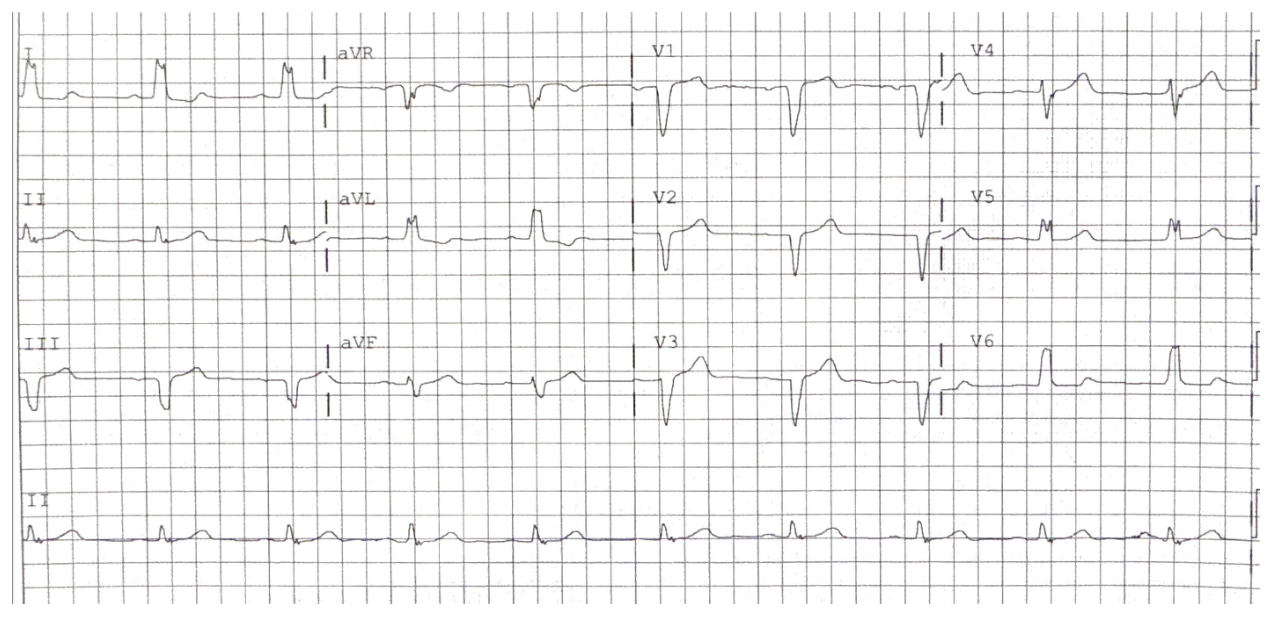
Upon arrival to the ED, initial VS showed a heart rate of 67, respiratory rate of 18 and blood pressure 186/81, with an oxygen saturation of 98% on room air and afebrile. She was awake and alert, answering questions appropriately. Her cardiac exam was unrevealing, with no murmur, rub or gallop appreciated. Lungs were clear and the abdomen was soft. She was able to fully range all extremities with no spine tenderness and no neurologic deficit. Her vascular access site in her right groin was healing well with minimal tenderness, no redness or swelling. As part of her ED evaluation, imaging of her head, face and neck were done as well as laboratory studies and an electrocardiogram (EKG). Her EKG is seen below:
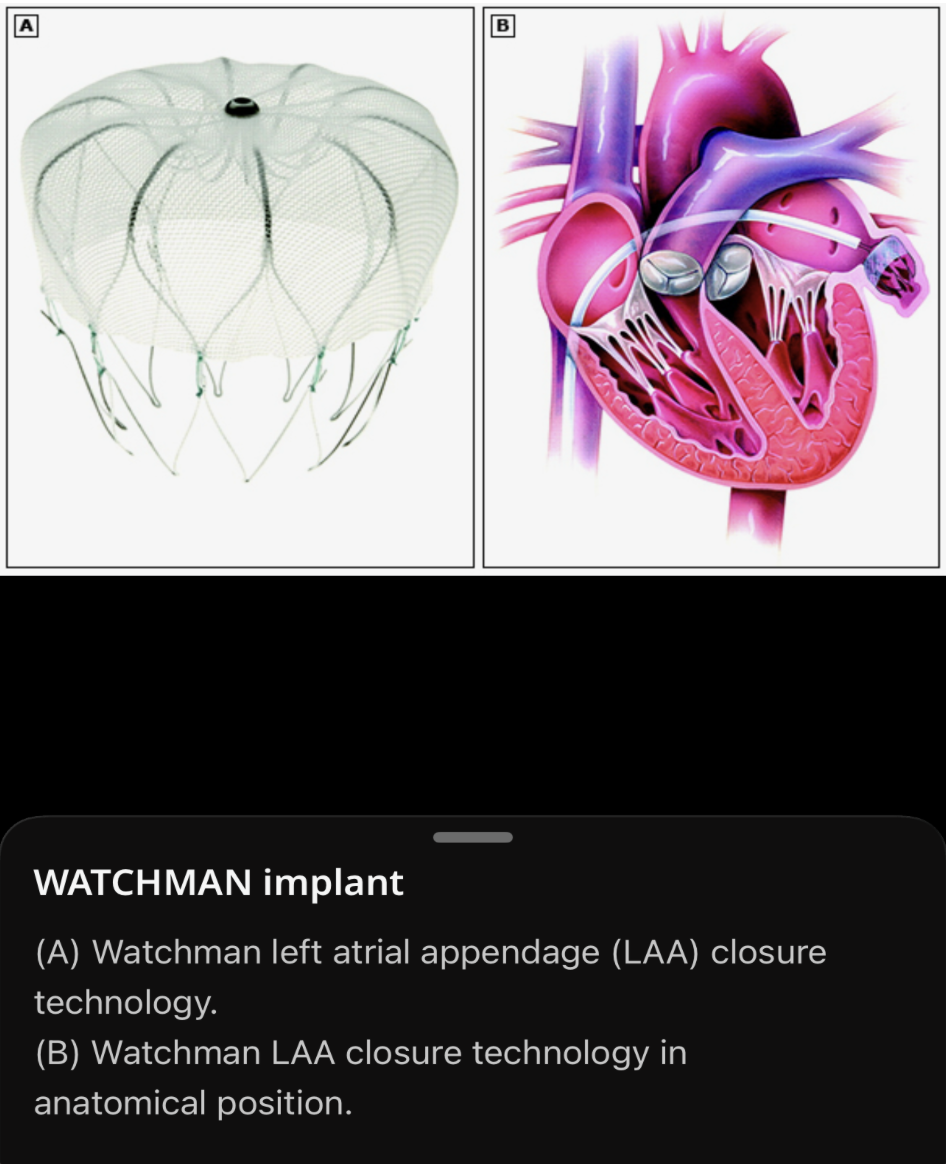
A WATCHMAN is a percutaneous endovascular left atrial appendage occlusion (LAAO) device that is used as an alternative to long-term anticoagulation for selected patients in atrial fibrillation who have an indication for anticoagulation but cannot take long-term anticoagulation. A WATCHMAN is implanted via femoral venous access with transseptal puncture into the left atrial appendage, typically under transesophageal echocardiography or intracardiac echocardiography guidance. It is a self-expandable cage with fixation anchors and a membrane that epithelializes over time.
The day after the procedure a transthoracic echocardiography is performed to assess for a pericardial effusion. A transesophageal echocardiography is completed between one and six months post-procedure to screen for device-related thrombus, residual leaks or a pericardial effusion. Complications can occur acutely (periprocedurally) or later due to the presence of the device, and close follow-up is required for early detection and management.
Early complications include pericardial effusion or tamponade and can occur due to trauma to the thin-walled left atrial or appendage tissue during transseptal access and device manipulation. Vascular complications from the femoral venous access are the most common periprocedural complication. Periprocedural stroke can occur from air embolism, peridevice leak or device-related thrombosis. Late device complications include device embolization (rare), device-related thrombus, residual peridevice leak, and device erosion, which is very rare but devastating.
While evaluating the patient, she remained hemodynamically stable and asymptomatic. Her physical exam was inconsistent with a large pericardial effusion and there was no evidence of vascular complication to her right lower extremity. Her computed tomography scans resulted and showed no evidence of significant traumatic injury. Laboratory results were largely reassuring; however, her initial troponin resulted at 32 ng/L and on repeat rose to 64 ng/L.
Given the event, the EKG showing a left bundle branch block, and the elevated troponin, her care was reviewed with cardiology and transfer for pacemaker was recommended. Per cardiology report with the new left bundle branch block and first degree atrioventricular block post transcatheter aortic valve replacement placed her at high risk for persistent complete heart black and met criteria for permanent pacemaker placement. WATCHMAN patients can commonly experience sinus node dysfunction seen as sinus bradycardia, sinus pauses or sinus arrests, which typically present as fatigue, dyspnea on exertion, lightheadedness or syncope. Atrioventricular block is a common pacemaker indication in severe forms such as complete atrioventricular block or Mobitz II, which can also include fatigue, dyspnea on exertion and syncope. Lastly, the history of atrial fibrillation carries concern for paroxysmal atrial fibrillation with long, symptomatic post-conversion pauses due to sinus dysfunction and is also an indication for pacemaker therapy.
Our patient was emergently transferred to a higher level of care where she underwent pacemaker implantation on day two of hospitalization. Post-procedurally she felt well and had no further symptoms. Telemetry showed ventricular pacing and she was ultimately discharged to home after enrolling in a cardiac monitoring program the following day with no further events.
Author
Kristina McAteer, MD is an Emergency Medicine Physician at Brown University Health