Precipitous Delivery in the Emergency Department

Anticipating Complications and Knowing How to Troubleshoot are Paramount
Case:
A 23-year-old G1P1 female with no significant past medical history presents to the emergency department with progressively worsening abdominal pain for the past week. She describes the pain as a sharp, intermittent, cramping pain in her lower abdomen. The pain is not associated with eating or movement and has become more frequent, lasting seconds at a time but occurring every few minutes now. She denies any fevers. She endorses some nausea but has not had any vomiting. She denies any diarrhea or sick contacts. She has not experienced any dysuria, vaginal bleeding, change in vaginal discharge but does report possible urinary incontinence earlier today. No previous surgical history. She currently has an IUD in place. Her only daily medication is a multivitamin.
Vitals:
HR: 120,BP: 112/76, RR: 16, T: 98.5 F, SpO2: 98% on room air
Physical exam:
General: Well-nourished female in mild distress
Cardiovascular: RRR, no murmurs or gallops, pulses 2+
Pulmonary: Breath sounds clear to auscultation bilaterally
Abdomen: Moderately distended, no significant tenderness to palpation, no rebound or guarding
Skin: Dry, warm, no rashes
Notable Labs:
WBC: 10.2 109/L
Hgb: 11.1 g/L
Plt: 164 109/L
Na: 137 mEq/L
K: 4.3 mEq/L
Cl: 100 mEq/L
CO2: 20 mEq/L
BUN: 12 mg/dL
Cr: 0.7 mg/dL
Glucose: 112 mg/dL
Total protein: 6.9 g/dL
Albumin: 3.6 g/dL
Total bilirubin: 0.3 mg/dL
ALT: 23 U/L
AST: 19 U/L
Lipase: 32 U/L
Lactate: 1.7 mmol/L
Serum qualitative beta hcg: Positive
Urinalysis: WBC 7, RBC 21
Imaging:
Abdominal/pelvic ultrasound: The ultrasound technician calls to inform you the transabdominal portion of the exam showed what appears to be a single full-term fetus, and the transvaginal portion of the exam couldn’t be completed as the patient’s cervix was dilated with the fetal head presenting through the birth canal.
Diagnosis:
Precipitous delivery in a cryptic pregnancy in the emergency department.
Discussion:
While all unexpected deliveries in the emergency department are uncommon, it is exceedingly rare to have unexpected delivery of a cryptic pregnancy. A cryptic pregnancy describes a situation where the pregnant person does not know they are pregnant. A term used as early as the 17th century, it previously applied to ‘concealed pregnancies’ where the pregnant person knew they were pregnant but chose to hide it. In modern terminology, it is usually divided into psychotic and nonpsychotic types [1]. One of the few population studies examining the epidemiology of this phenomenon estimated approximately 1 in 2500 pregnancies go unnoticed until delivery [2]. These pregnancies tended to not have significant weight gain or morning sickness. Another prospective study found higher risks of nonpsychotic cryptic pregnancies in patients who were younger, less well-educated, not in a relationship with the father of the fetus and had a psychiatric history such as depression. There was no significant difference in BMI, parity or gestational age at delivery compared to non-cryptic pregnancies. Approximately 75% of these women were taking contraception of some kind [3].
Among the many other concerns of cryptic pregnancies, including lack of prenatal care and the psychological toll on the mother and family, ensuring the providing team is prepared for a precipitous delivery is paramount to minimizing complications. EMRAP provides multiple videos and guidelines for precipitous delivery, which are summarized below [4].
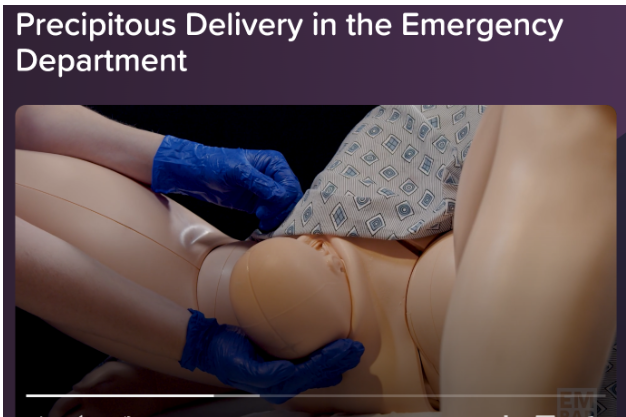
Video 1. Precipitous Delivery in the ED. [https://www.emrap.org/episode/deliveries/normaldelivery]
The provider should prioritize assessing the following to be prepared for any complications:
Approximate gestational age
Number of fetuses
Presence or absence of fetal heart rate
Whether there has been a spontaneous rupture of membranes
Timing of contractions
Any relevant prenatal history prior to this pregnancy
Equipment needed at bedside includes:
Towels and blankets
A scalpel or scissors
2 clamps for the umbilical cord
PPE
Oxytocin 10 units (to be administered intramuscularly after delivery)
Basic steps of delivery:
Support the perineum
Once the head delivers, the baby will typically restitute (rotate 90 degrees)
Check for nuchal cord and reduce if necessary
With the next contraction, apply gentle downward traction to deliver the anterior shoulder
Typically, the posterior shoulder will follow spontaneously; otherwise, apply gently upward traction
If the baby appears healthy (good tone, color, crying), hand the baby to the mother for skin-to-skin
If there is any indication of distress, clamp and cut the cord and have a team member ready to resuscitate the baby
Cutting the cord:
For a healthy-appearing baby, delayed cord clamping (for at least 60 seconds) is recommended
Clamp the cord at approximately 3 cm and 5 cm from the baby’s umbilicus
Cut the cord between the clamps
Placenta delivery and postpartum assessment:
The placenta should deliver within 30 minutes following the baby
Placenta delivery is preceded by lengthening of the cord and a trickle of blood
One contraction should deliver the placenta
Inspect the placenta to ensure it is fully intact. If it is not intact, the provider must perform a uterine sweep (insert a gloved, lubricated finger through the cervix and gently move it in a circular motion) to prevent postpartum hemorrhage that could be caused by any retained placental parts
Perform a uterine massage with one hand placed at the lower uterine segment and the other at the fundus
Uterine massage and oxytocin should cause the uterus to contract
Consider a one-time dose of IV antibiotics if a uterine sweep is performed
Common complications with any precipitous delivery include breech presentation, shoulder dystocia, and nuchal cord. EMRAP also provides instructive videos and instructions to troubleshoot these complications, as summarized below.
Breech presentation:

Video 2. Breech Delivery. [https://www.emrap.org/episode/deliveries/breechdelivery]
There are three types of breech presentation:
Frank breech (baby’s buttock is the presenting part with hips flexed and knees extended upward) — this is the most favorable breech presentation as it is most likely to maximally dilate the cervix
Complete breech (baby’s buttock is the presenting part with hips and knees flexed or crossed)
Footling breech (baby’s foot is the presenting part) – this is the least favorable because the cervix is unlikely to dilate
Maintain HANDS OFF the presenting part in a breech delivery. Do not apply traction or attempt to speed up the delivery.
Keep the baby’s back anterior in case you do have to assist the delivery.
Consider assisting only if the delivery is not progressing
Assistive delivery maneuvers of the legs
Place your fingers behind the baby’s anterior knee, flex the knee and the hip to deliver the foot
Assistive delivery maneuvers of the arms
Grasp the baby’s bony pelvis and rotate the baby 90 degrees in either direction so one arm is anterior
Slide your fingers in front of the baby’s elbow, flex the elbow, sweep the baby’s arm in front of the face and deliver the posterior arm (relative to the birthing patient)
Rotate the baby 180 degrees in the other direction and deliver the other arm in the same fashion
Rotate the baby again so the back is anterior
Assistive delivery maneuvers of the head
Place your lower hand in the vagina and support the baby’s torso and face
Place your upper hand in the vagina and flex the baby’s head forward (chin to chest)
Lift the baby’s buttock upwards to deliver the head
Shoulder Dystocia [6]:
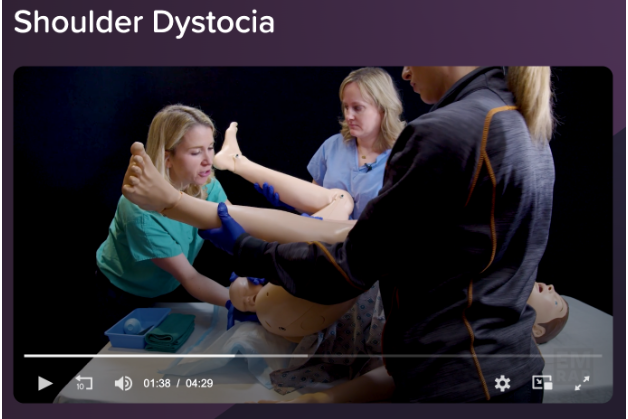
Video 3. Shoulder Dystocia. [https://www.emrap.org/episode/deliveries/shoulderdystocia]
Signs of shoulder dystocia include failure to deliver the anterior shoulder within 1-2 pushes, Turtle sign (baby’s head delivers then retracts back), or if baby’s head appears flushed or bloated
If identified, immediately call for help from the obstetrics team if available
Delivery assist maneuvers
McRoberts maneuver: an assistant on each side hyperflexes the mother’s hips with her knees bent
Suprapubic pressure: an assistant applies either constant or pulsatile suprapubic pressure, ideally in the direction of the fetus’s face (to help deduce the diameter of the fetal shoulders)
If there is no movement of the baby after 30 seconds, attempt delivery of the posterior arm. Place your lower hand in the vagina and reach for the baby’s posterior wrist, flex the baby’s elbow to deliver the posterior arm
Again, if there is no movement of the baby after 30 seconds, continue McRoberts maneuver and suprapubic pressure and attempt to rotate the baby either clockwise or counterclockwise
If there is still no movement of the baby after 30 seconds, reverse the direction of rotation.
Reduction of Nuchal Cord [7]:

Video 4. Reduction of Nuchal Cord. [https://www.emrap.org/episode/deliveries/nuchalcord]
After delivery of the head, check for a nuchal cord (umbilical cord wrapped around baby’s neck)
If it is loose enough, attempt to reduce the cord by sliding it over the baby’s head
If it is irreducible and delivery is not promptly continuing, have the mother pause pushing, clamp the cord, cut the cord between the clamps, and deliver the baby.
Case Resolution:
The radiologist reviewing the transabdominal ultrasound estimated the gestational age to be around 31-32 weeks. A type & screen was promptly sent, and it was determined the patient did not need RhoGAM. The patient was found to have had spontaneous rupture of membranes and promptly delivered the fetus in the ED in the next hour with no significant complications. She received oxytocin after delivery and experienced no significant postpartum hemorrhage. The patient was unaware that she was pregnant due to the presence of the IUD and the lack of any significant symptoms such as morning sickness or significant weight gain. She had no psychiatric history and no psychiatric symptoms. The patient and her baby were transferred to an outside hospital with an obstetrics and neonatal unit in stable condition.
Takeaway points:
Although cryptic pregnancies and precipitous deliveries are rare, it is important to be prepared for them, anticipate complications, and know how to troubleshoot
Always make sure to order a Type & Screen and provide RhoGAM if indicated
Ensure Oxytocin is available to give immediately after delivery to prevent postpartum hemorrhage
Be familiar with assistive maneuvers for common delivery complications such as breech delivery, shoulder dystocia and nuchal cord reduction.
AUTHOR:
Jordan Ozolin, MD is a former resident and current attending physician in the Department of Emergency Medicine at Alpert Medical School of Brown University.
FACULTY REVIEWERS:
Ilse Jenouri, MD, MBA, FACEP is a Clinical Professor in the Department of Emergency Medicine at Alpert Medical School of Brown University and Co-Medical Director of the Emergency Department at Women and Infants Hospital.
Eilean Attwood, MD, MPH, MBA FACOG is an Assistant Professor of Obstetrics and Gynecology, Clinician Educator at Alpert Medical School of Brown University and Co-Medical Director, Emergency Department, Obstetrics & Gynecology at Women and Infants Hospital.
References:
Duckitt K. Cryptic pregnancy. Case Rep Womens Health. 2023 Apr 2;38:e00503. doi: 10.1016/j.crwh.2023.e00503. PMID: 37440764; PMCID: PMC10334309.
Wessel J, Buscher U. Denial of pregnancy: population based study. BMJ. 2002 Feb 23;324(7335):458. doi: 10.1136/bmj.324.7335.458. PMID: 11859048; PMCID: PMC65667.
Delong H, Eutrope J, Thierry A, Sutter-Dallay AL, Vulliez L, Gubler V, Saad Saint-Gilles S, Tessier E, Le Foll J, Viaux S, Apter G, Danion A, Auer J, Rolland AC; Pregnancy Denial Study Group. Pregnancy denial: a complex symptom with life context as a trigger? A prospective case-control study. BJOG. 2022 Feb;129(3):485-492. doi: 10.1111/1471-0528.16853. Epub 2021 Aug 19. PMID: 34324258; PMCID: PMC9291172.